

THRYVE Team
Wellness Clinic
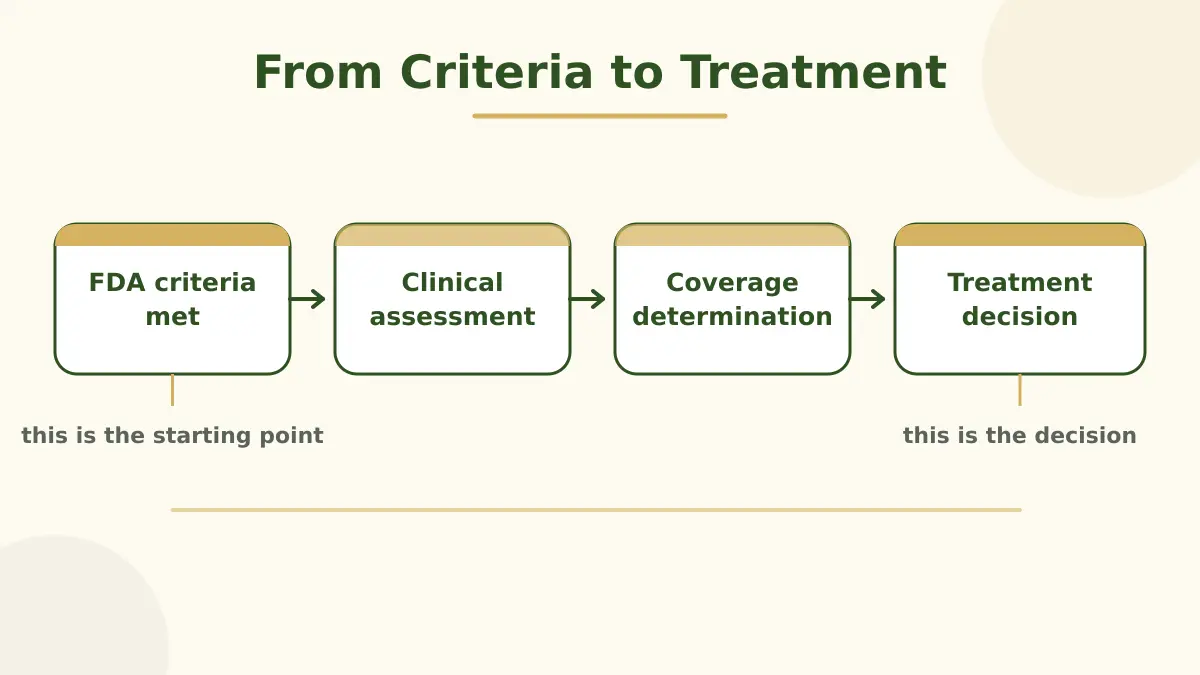
The FDA criteria for weight management medications are public, specific, and easier to find than most people expect. What is harder to find is an honest account of what happens after you meet them, which is where most of the actual decision takes place.
Under current FDA labeling, semaglutide and tirzepatide are approved for chronic weight management in adults with a BMI of 30 or higher, or a BMI of 27 or higher with at least one weight-related condition, as an adjunct to a reduced-calorie diet and increased physical activity. Meeting those criteria makes someone potentially eligible. It does not determine whether the medication is appropriate for them, which depends on medical history, contraindications, and a prescriber's assessment.
Asking “Am I a candidate for semaglutide?” usually produces one of two unhelpful answers. Either a BMI threshold presented as though it settles the matter, or a vague instruction to consult a doctor with nothing to consult them about.
The criteria governing GLP-1 eligibility are public and specific, and there is no reason not to state them plainly. What follows covers what the labels actually say, who they exclude, what insurers require beyond them, and what happens in the gap between meeting the criteria and receiving a prescription.

What the FDA Labels Actually Say
Both Wegovy and Zepbound use the same framework for chronic weight management in adults.
Route | Requirement |
BMI of 30 or higher | Meets the BMI criterion without an additional weight-related condition |
BMI of 27 to 29.9 | Meets the BMI criterion with at least one weight-related condition |
The Zepbound label names examples of qualifying conditions including hypertension, dyslipidemia, type 2 diabetes, obstructive sleep apnea, and cardiovascular disease. The Wegovy framework is the same.
One phrase appears in both labels and gets dropped from almost every article about GLP-1 eligibility: these medications are indicated as an adjunct to a reduced-calorie diet and increased physical activity. That is part of the approved indication rather than a footnote, and it shapes what treatment involves.
A common source of confusion
Ozempic and Mounjaro are not weight management approvals. They contain the same active ingredients as Wegovy and Zepbound respectively, but they are FDA-approved for type 2 diabetes, at different doses, under different labels.
Someone asking who qualifies for semaglutide may be thinking of Ozempic while the eligibility criteria they find apply to Wegovy. The active ingredient is the same. The approved use is not.
Newer options
Foundayo, orforglipron, received FDA approval on 1 April 2026 and is taken orally rather than by injection. Its weight-management indication similarly covers adults with obesity or adults with overweight in the presence of at least one weight-related comorbid condition. Saxenda, liraglutide, carries the same BMI thresholds.
Wegovy and Zepbound also carry additional approvals beyond weight management. Wegovy has a cardiovascular risk reduction indication for certain adults, and Zepbound has an approval for moderate-to-severe obstructive sleep apnea in adults with obesity. Those are separate indications with their own criteria.
Why BMI Is the Criterion Even Though It Is Imperfect
BMI has important limitations as a measure of an individual's health, while remaining a practical criterion for population-level treatment eligibility. Both of those are true at once, and understanding why explains a great deal about how eligibility works.
A muscular person with low body fat can have a BMI of 30 without carrying excess fat. A sedentary person can have a BMI of 27 and carry substantial metabolic risk. BMI does not distinguish between them, because it is calculated from height and weight alone.
BMI remains widely used because it is simple, standardized, and easily documented. Its limitations are one reason a prescriber considers information beyond BMI when assessing whether treatment is appropriate for an individual.
The practical implication is that BMI determines whether someone clears an administrative gate. It does not determine whether treatment is clinically appropriate, and those are genuinely different questions.
Who Should Not Take These Medications
This is the half of the question most articles skip, and it matters more than the BMI threshold for anyone it applies to.
Both semaglutide and tirzepatide carry an FDA boxed warning concerning thyroid C-cell tumors observed in animal studies. The prescribing information identifies specific personal or family medical histories in which these medications are contraindicated.
Current prescribing information also includes gastrointestinal and other warnings and precautions that a prescriber should consider in the context of an individual's medical history.
This article deliberately does not list every contraindication. Who should not take tirzepatide or semaglutide is determined by reviewing an individual's full medical history against current prescribing information, not by checking a summary online. A list here would invite people to rule themselves in or out on incomplete information, which is the opposite of useful.
What Insurance Requires Beyond the FDA Criteria
Meeting the FDA criteria and having treatment covered are separate things, and the gap between them can create an additional barrier.
Insurance coverage requirements can differ from the FDA-approved indication and may include additional criteria. Some plans set a higher BMI threshold for coverage purposes. Some require documented attempts at other approaches first, known as step therapy. Some exclude weight management medications as a category regardless of labeling.
What plans commonly add | What it means in practice |
Higher BMI threshold | Some plans set their own threshold above the FDA criteria for coverage purposes |
Documented comorbidity | A qualifying condition may need to appear in the medical record with a diagnosis code, not simply be reported |
Step therapy | A preferred alternative may need to be tried first |
Prior authorization | Clinical documentation submitted and approved before coverage begins |
Category exclusion | Some plans exclude weight management drugs as a class |
This is worth knowing before rather than after. Someone who meets the FDA criteria comfortably can still find coverage denied on grounds that have nothing to do with whether the medication is clinically appropriate for them.
If You Are Close to a Threshold
A BMI of 26.8 and a BMI of 27.2 describe almost identical people. One clears the administrative gate and one does not, which is a limitation of thresholds rather than a meaningful clinical distinction.
A few things are worth knowing in that situation:
BMI changes with weight, so a measurement taken at one point may not reflect a current value
A qualifying condition that has not been formally diagnosed is not documented, and documentation is what criteria operate on
Weight management involves approaches beyond medication, and a prescriber can discuss those regardless of whether a threshold is met
Not meeting criteria for one medication does not mean no option exists
What is not worth doing is attempting to influence a measurement to clear a threshold. Eligibility thresholds are administrative and regulatory criteria, and attempting to influence a measurement does not change the underlying clinical picture.

What a Prescriber Assesses Beyond the Criteria
Meeting the FDA criteria establishes potential eligibility. What happens next is an assessment, and it covers considerably more ground.
Personal and family medical history, reviewed against contraindications
Current medications and potential interactions
Other conditions that may affect suitability or require monitoring
What has been tried previously and how it went
Whether the medication's administration and treatment schedule are manageable
Coverage, which often narrows options considerably
Whether medication is the appropriate next step at all
That last point is not a formality. A prescriber concluding that medication is not the right approach for a particular person is making a clinical judgment, not withholding something.
Frequently Asked Questions
Am I eligible for semaglutide if my BMI is 27?
Eligibility for semaglutide at a BMI of 27 depends on an additional factor. Under FDA labeling, a BMI of 27 to 29.9 meets the criterion for the chronic weight management indication if at least one weight-related condition is also present. The labels name examples including hypertension, type 2 diabetes, dyslipidemia, obstructive sleep apnea, and cardiovascular disease. Without a qualifying condition, a BMI in that range generally does not meet the adult criteria.
What is the BMI requirement for weight loss medication?
The BMI requirement for FDA-approved chronic weight management medications in adults is a BMI of 30 or higher on its own, or a BMI of 27 or higher with at least one weight-related condition. Insurance coverage requirements may differ from the label.
Does having type 2 diabetes change anything?
It is one of the qualifying conditions for the weight management indication at the lower BMI threshold. Separately, Ozempic and Mounjaro are approved specifically for type 2 diabetes rather than for weight management, which is a different indication with different labeling.
Can I qualify without a diabetes diagnosis?
Yes. The chronic weight management indication does not require diabetes. A BMI of 30 or higher can meet the BMI criterion without a weight-related comorbidity, and several other conditions can serve as the qualifying comorbidity at the lower threshold.
Who should not take tirzepatide or semaglutide?
Both carry a boxed warning concerning thyroid C-cell tumors observed in animal studies, and prescribing information describes specific personal and family medical histories that make them inappropriate. Suitability is determined by a prescriber reviewing full medical history rather than from a summary.
Does meeting the criteria mean I will get a prescription?
No. The criteria establish potential eligibility. Whether the medication is appropriate depends on medical history, contraindications, other medications, and a prescriber's clinical assessment. Coverage is a further separate question.
Final Thoughts
The FDA criteria are not a secret and they are not complicated. For the adult chronic weight-management indication discussed here, the framework begins with a BMI of 30 or higher, or 27 or higher with a qualifying weight-related condition, alongside diet and physical activity changes.
What those criteria establish is that someone may be eligible. They say nothing about whether the medication suits a particular person, which depends on history and contraindications, and nothing about whether it will be covered, which depends on a plan.
So the useful version of the question is not whether you meet a threshold. It is what an assessment would find, and that requires a conversation rather than a calculation.
An Assessment Rather Than a Threshold
THRYVE Wellness Medical provides provider-led medical weight management by telehealth, with eligibility assessed against your medical history and circumstances rather than a single measurement. Available to eligible patients in Texas, South Carolina, and North Carolina.
Book a consultation with THRYVE
CTA NOTE: must not be edited to imply that booking results in a prescription, or that THRYVE will prescribe a particular medication. This article argues that meeting criteria is not the decision, and a CTA implying otherwise contradicts it directly. Given FDA enforcement activity on GLP-1 marketing, any CTA change here should go through compliance.
Medical Disclaimer: This article is for general educational purposes and is not a substitute for individualized medical advice, diagnosis, or treatment. It cannot determine whether any medication is appropriate for you. These medications are available by prescription only. Speak with a qualified healthcare professional about your own circumstances.