

THRYVE Team
Wellness Clinic
A comprehensive metabolic panel returns fourteen measurements from a single blood sample, and most people meet it at a routine checkup while feeling perfectly well. Here is what each group of markers covers, and how a flagged result is actually interpreted.
A comprehensive metabolic panel is a blood test measuring 14 substances from a single blood sample. It covers blood sugar, kidney-related markers, liver-related markers, blood proteins, and electrolyte balance. It is commonly used as part of routine healthcare, which is why many people first encounter a CMP during a checkup rather than because of a specific diagnosis.
Because it measures fourteen things at once, a cmp blood test produces more numbers than most tests. That breadth is the point of it, and it is also why a report can look more complicated than it is.
This covers what each marker group examines, how the panel differs from a basic one, what fasting is required, and what a single flagged value on a fourteen-item report generally means. It applies whether your order says CMP, complete metabolic panel, or simply metabolic panel, since those refer to the same test.

What Is a Comprehensive Metabolic Panel?
A comprehensive metabolic panel is a routine blood test that measures 14 different substances in a single blood sample. It provides information about metabolism, meaning how the body uses food and energy, and about the balance of certain chemicals in the blood.
The 14 measurements are performed from the same blood sample rather than requiring a separate procedure for each marker.
You may see the test described as a CMP, comprehensive metabolic panel, complete metabolic panel, or simply metabolic panel. When the wording is unclear, the list of included tests on the order or report confirms which panel was performed.
What Are the 14 Tests in a CMP?
The 14 markers fall into five groups. Laboratories usually print them in roughly this order.
Group | Markers | What the group examines |
Blood sugar | Glucose | The body's main energy source |
Electrolytes | Sodium, potassium, chloride, carbon dioxide (bicarbonate) | Fluid balance, nerve and muscle function, and acid-base balance |
Minerals | Calcium | A mineral involved in nerve, muscle and bone function |
Kidney | BUN (blood urea nitrogen), creatinine | How well the kidneys are clearing waste |
Proteins | Albumin, total protein | Proteins made largely by the liver, involved in fluid balance and transport |
Liver | ALP, ALT, AST, bilirubin | Liver enzymes and a waste product from red blood cell breakdown |
Most laboratories run the same 14 tests, though the exact composition can vary slightly by laboratory and by what the ordering provider is looking for.
Many laboratory reports also include an estimated glomerular filtration rate, or eGFR. It is an estimate calculated using an equation rather than a separate substance measured as part of the CMP. Common adult equations may use serum creatinine along with factors such as age and sex, which is why an eGFR can appear alongside CMP results without being counted among the 14 measurements.
What Is the Difference Between a CMP and a BMP?
A basic metabolic panel includes 8 of the 14 tests. A comprehensive metabolic panel is the same 8 plus 6 more: the liver markers ALP, ALT, AST and bilirubin, and the proteins albumin and total protein.
The shorter panel is usually identified as a basic metabolic panel or BMP. The practical difference between a BMP and CMP is the six additional protein and liver-related measurements included in the CMP.
Comparison | Basic metabolic panel (BMP) | Comprehensive metabolic panel (CMP) |
Number of tests | 8 | 14 |
Glucose | Yes | Yes |
Electrolytes and calcium | Yes | Yes |
Kidney markers | Yes | Yes |
Liver markers | No | Yes |
Proteins | No | Yes |
So the comparison reduces to a single question: does the order include the liver and protein work. Everything else is shared.
Neither panel includes cholesterol. Lipid testing is a separate panel, though the two are frequently ordered together at a routine checkup, which is one reason people assume a CMP covers it.
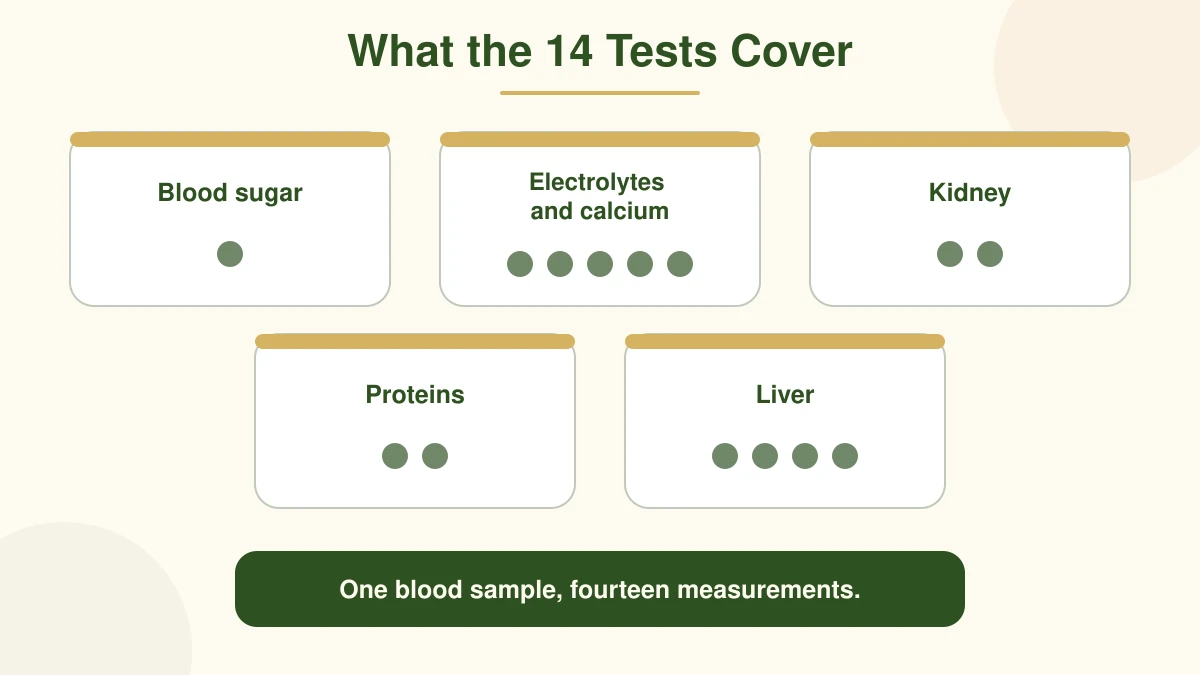
What Does Each Group Actually Tell You?
Glucose
Measures blood sugar at the moment the sample was taken. Glucose can be affected by recent food intake, which is one reason fasting may be requested for some CMP orders.
Electrolytes and calcium
Sodium, potassium, chloride and bicarbonate control fluid balance and nerve and muscle function. Calcium is involved in nerve, muscle and bone function. These values are sensitive to hydration, medications, and recent illness.
Kidney markers
BUN and creatinine are waste-related measurements commonly used when assessing kidney function. Their levels can also be influenced by factors outside kidney disease, including hydration and, particularly for creatinine, muscle mass.
Proteins
Albumin is a protein made by the liver that transports substances through the bloodstream and helps keep fluid inside blood vessels. Total protein measures albumin along with other blood proteins.
Liver markers
ALT and AST are enzymes found in liver cells. ALP relates to the bile ducts and to bone activity. Bilirubin is a waste product from the breakdown of red blood cells that the liver processes. Together, these measurements can provide information relevant to liver and biliary health, but they are interpreted alongside one another and in clinical context.
Cleveland Clinic’s overview of the comprehensive metabolic panel provides additional detail on what the individual CMP measurements assess.
Each marker is interpreted in the context of the others rather than individually, which is the main reason the panel exists as a panel rather than as fourteen separate tests.
What Does One Flagged Value on a CMP Mean?
A single result outside its reference range does not establish a diagnosis by itself. CMP results are interpreted together because the significance of one flagged value depends on which measurement is abnormal, how far it is outside the laboratory's reference range, the other CMP results, symptoms, health history, medications, and other relevant factors.
Reference ranges describe values expected for a defined reference population, but an individual result just outside a range can have different explanations. Conversely, a result within range does not answer every clinical question. The flag is therefore a reason to interpret the result in context rather than a diagnosis on its own.
Patterns can matter. One liver-related measurement outside its range may carry different information from several related measurements changing together. The same result can also mean something different when symptoms or previous laboratory trends are considered.
MedlinePlus states that providers compare all CMP results and consider health history, medicines and other factors, and that abnormal results may require additional tests to confirm or rule out a diagnosis.
Some CMP measurements can also be influenced by factors such as hydration, recent food intake, medications, illness, and physical activity. Which factors matter depends on the measurement and the circumstances of the test.
Do You Need to Fast for a CMP?
Some CMP orders require fasting and others do not. If fasting is requested, the instructions commonly specify a period such as 8 to 12 hours. Follow the preparation instructions supplied with your order because requirements can vary.
Plain water is generally permitted during many fasting blood tests. Our guide to fasting before a blood test explains common preparation instructions and what to do if you have already eaten.
When Is a CMP Ordered?
A comprehensive metabolic panel is commonly ordered as part of a routine physical or general health panel test, when starting or monitoring certain medications that affect the liver or kidneys, or when investigating symptoms that could involve metabolism, the liver, the kidneys or fluid balance.
A routine blood-work order may include a metabolic panel alongside a complete blood count and lipid panel. These are separate tests even when blood for them is collected during the same visit, which is what is usually meant by a full blood work panel or a basic blood panel.
If you're considering testing outside a traditional office visit, our guide to direct-to-consumer lab testing explains what to consider before ordering laboratory tests yourself.
It is also used to monitor known conditions over time. When a CMP is repeated, trends across results may provide additional context alongside individual readings.

What a CMP Cannot Tell You
A CMP can provide information that helps a clinician decide whether a result needs further evaluation. It does not confirm a diagnosis on its own.
It does not diagnose. An elevated glucose may point toward further testing rather than establishing a condition
It does not include cholesterol or lipids, which require a separate panel
It does not include thyroid testing, a complete blood count, or vitamin levels
It does not distinguish between causes. An abnormal measurement can have more than one possible explanation.
Treating the panel as an opening question rather than a final answer is the framing that makes it useful. The results tell a clinician where to direct attention, and what happens next depends on the full picture rather than on the report alone.
Frequently Asked Questions
What is a comprehensive metabolic panel?
A comprehensive metabolic panel is a blood test measuring 14 substances from a single sample. It includes glucose, electrolytes, calcium, kidney-related measurements, blood proteins, and liver-related measurements, providing information about metabolism and several aspects of organ health.
What are the 14 tests in a CMP?
Glucose; the electrolytes sodium, potassium, chloride and carbon dioxide; calcium; the kidney markers BUN and creatinine; the proteins albumin and total protein; and the liver markers ALP, ALT, AST and bilirubin.
What is the difference between a CMP and a BMP?
A basic metabolic panel includes 8 tests. A comprehensive metabolic panel includes those same 8 plus 6 more covering liver function and blood proteins, for 14 in total.
What is a BMP blood test?
A basic metabolic panel is an 8-test blood panel covering glucose, calcium, the four electrolytes, and the kidney markers BUN and creatinine. It is the comprehensive panel without the liver and protein markers, and appears on orders as BMP, bmp test or bmp laboratory test.
Is a metabolic panel the same as a CMP?
Usually, yes. Metabolic panel, complete metabolic panel and CMP generally refer to the same 14-marker test. If an order specifies basic metabolic panel, that is the shorter 8-test version. Check the order itself when the wording is ambiguous.
Does a CMP include cholesterol?
No. Cholesterol and other lipids require a separate lipid panel. The two are often ordered together at routine checkups, which is why they are frequently assumed to be one test.
Do you have to fast for a comprehensive metabolic panel?
Some CMP orders require fasting and others do not. When fasting is requested the instructions commonly specify a period such as 8 to 12 hours, and plain water is generally permitted. Follow the instructions supplied with your order, since requirements can vary.
What does one abnormal value on a CMP mean?
A single value outside its reference range does not establish a diagnosis by itself. Its significance depends on which measurement is abnormal, the degree of the difference, other CMP results, symptoms, medical history, medications, and other relevant factors.
How long do CMP results take?
Turnaround varies by laboratory. Ask the provider or laboratory that arranged the test, since the timing depends on how the sample is processed rather than on the panel itself.
Is a CMP the same as a full liver panel?
No. A CMP includes several measurements relevant to liver health, but it is not synonymous with every test or panel used to evaluate the liver. The exact contents of a dedicated full liver panel can vary by laboratory and clinical purpose.
Final Thoughts
A comprehensive metabolic panel returns fourteen measurements covering blood sugar, electrolytes, kidney-related markers, proteins and liver-related measurements. A CMP includes the same eight measurements as a BMP plus six additional protein and liver-related measurements.
If one result is flagged, the flag should be interpreted in context rather than treated as a diagnosis by itself. Which measurement is affected, how far it differs from the reference range, related results, symptoms, medical history and previous testing can all matter.
The panel provides information that can guide the next clinical question; it does not determine the answer on its own.
Results Reviewed With a Provider
THRYVE Wellness Medical offers at-home blood collection by licensed phlebotomists for eligible patients, with provider-guided care available through telehealth. Services are available to eligible patients in Texas, South Carolina, and North Carolina.
Medical Disclaimer: This article is for general educational purposes and is not a substitute for individualized medical advice, diagnosis, or treatment. It cannot interpret your results. Speak with the provider who ordered your tests about what your particular values mean.