

THRYVE Team
Wellness Clinic
Heavy metal testing can use different types of samples, but the right specimen depends on the metal being investigated and the suspected exposure. Learn what determines test selection, how results are interpreted, and why one widely marketed testing approach is discouraged by medical toxicologists.
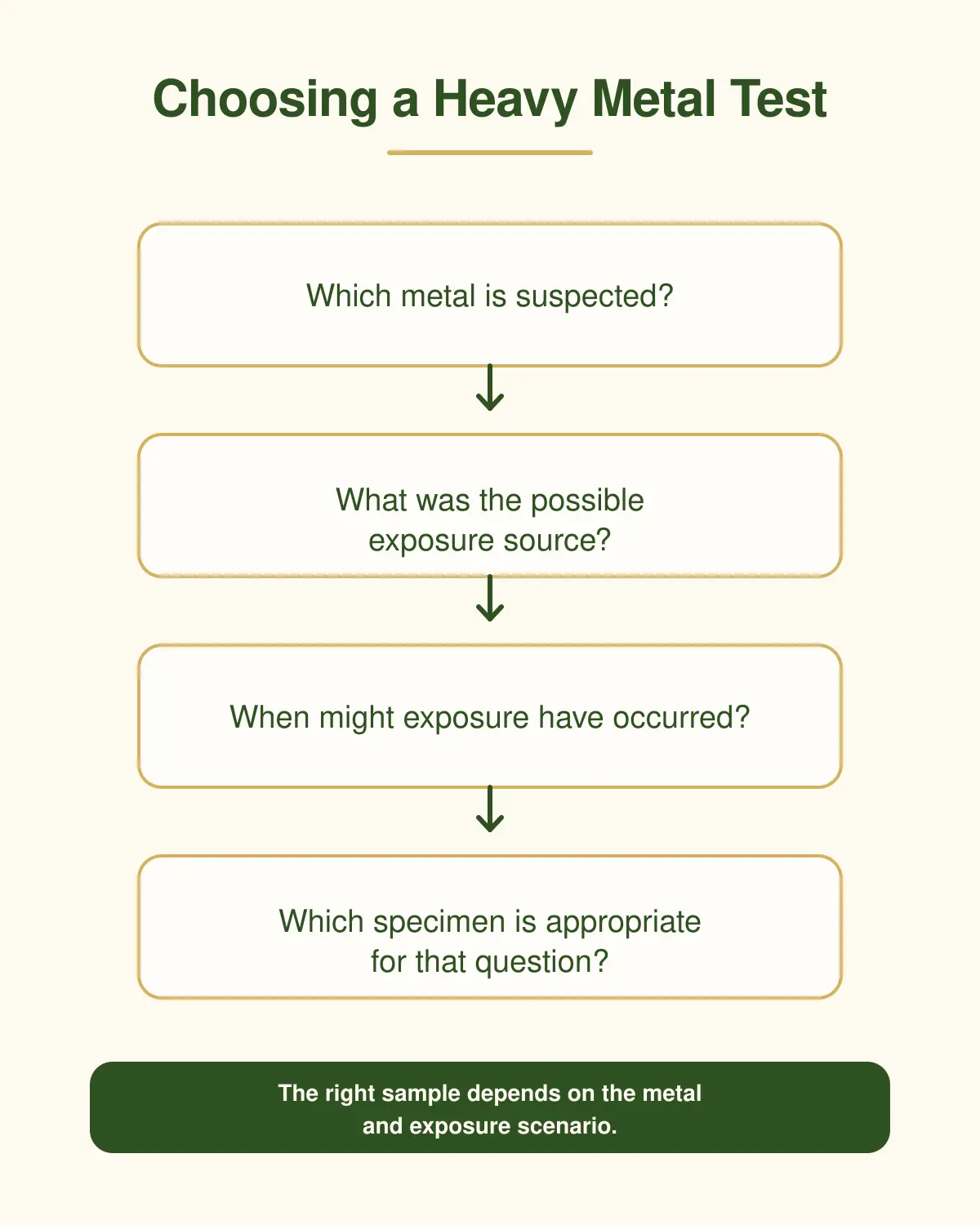
Heavy metal testing measures metals such as lead, mercury, arsenic and cadmium in biological samples. Blood and urine are commonly used, while hair or nails may be used in more specific circumstances. The appropriate sample depends on which metal is being investigated, the suspected source of exposure, and when the exposure may have occurred. Because some level of certain metals may be detectable in people without poisoning, detection alone does not establish toxicity.
Most people searching for a heavy metal test are not asking an academic question. They suspect an exposure, or they have symptoms without an explanation, and they want to know whether testing would tell them anything.
The honest answer depends on which sample is used and what question is being asked, because those two things have to match. This covers both, along with one widely sold test that mainstream toxicology does not accept.

What Are Heavy Metals?
Heavy metals are dense metallic elements found naturally in the environment. Some, including lead, mercury, arsenic and cadmium, can be harmful to health at elevated levels.
They are also unavoidable. MedlinePlus notes that because heavy metals are found just about everywhere, it is normal to have some level of them in the body. The concern is not presence but quantity.
Common routes of exposure include older housing with lead paint or legacy plumbing, certain fish, contaminated water or soil, some industrial and agricultural work, and occasionally certain supplements or imported products.
What Does Heavy Metal Testing Measure?
Heavy metal testing includes a group of tests measuring levels of potentially harmful metals in a sample of blood, urine, hair, fingernails or other tissue. A standard heavy metal panel typically covers lead, mercury, arsenic and cadmium, though the exact composition varies by laboratory and by what is being investigated.
Which metals are included, and which sample is appropriate, depends on what is being investigated. That is the practical starting point for anyone comparing options.
Blood, Urine or Hair: Which Sample?
This is the part that determines whether a test answers your question, and it is where most confusion sits. It is also where most articles on this topic oversimplify.
Sample | Where it may fit | Important limitation |
Blood | Commonly used for heavy metal testing; appropriate for certain metals and exposure scenarios | How long a metal remains informative in blood varies by metal and exposure |
Urine | Commonly used for certain metals, including some recent-exposure assessments | Interpretation depends on the metal, specimen type and collection method |
Hair or nails | May provide information in selected exposure investigations | Clinical usefulness varies by metal, and external contamination and reference-range limitations can complicate interpretation |
There is no single specimen that is best for every heavy-metal question. The appropriate choice depends on the metal being investigated and the suspected timing and route of exposure.
Cleveland Clinic notes that the sample used for heavy metal testing can depend on the metal being tested and whether the suspected exposure was short- or long-term.
This matters because a sample that is appropriate for one metal or exposure window may be less informative for another. Choosing the test therefore starts with the suspected metal and exposure history rather than with blood, urine or hair as interchangeable options.
One Test Worth Knowing About Before You Buy It
Provoked urine testing, sometimes called a challenge test, involves taking a chelating agent before collecting the urine sample. The American College of Medical Toxicology advises against using post-chelator challenge urine testing to diagnose metal toxicity or to determine whether additional chelation is needed.
Chelating agents can increase urinary elimination of metals even in people whose body burden falls within a reference population, and validated reference ranges have not been established for interpreting post-challenge specimens. Comparing a provoked result with reference ranges developed for non-provoked urine can therefore produce misleading conclusions.
Because chelation itself increases urinary metal excretion, post-challenge results cannot be interpreted using reference ranges established for non-provoked urine specimens. This can make results appear elevated relative to an inappropriate comparison range.
This matters because provoked testing may be marketed to people who are already concerned about metal exposure. If a provider proposes it, asking how the result will be interpreted and which reference values will be used is a reasonable question.
Heavy Metal Poisoning Symptoms
Heavy metal poisoning symptoms are largely non-specific, meaning they overlap with many common conditions. That is the central difficulty with using symptoms to decide whether testing is warranted.
Reported heavy metal symptoms vary by which metal is involved and can include digestive effects such as nausea, vomiting or abdominal pain, persistent fatigue and weakness, and neurological effects. Metal poisoning symptoms overlap heavily with ordinary illness. Severity ranges considerably.
This is not a checklist for self-assessment. These symptoms can occur with many other conditions, so matching a symptom list does not establish heavy-metal exposure or poisoning. Symptoms are a reason to seek appropriate evaluation, particularly when there is a plausible exposure history.
What makes testing more likely to be useful is a plausible exposure rather than a matching symptom. Occupational exposure, a known contaminated water source, older housing with lead paint, or high consumption of certain fish are the kinds of history that make a heavy metal poisoning test worth discussing.
Who Should Consider Testing?
Testing for heavy metals is generally most informative when there is a specific reason to suspect exposure.
A known or suspected exposure event
Occupational exposure in industries working with these metals
Living in older housing with lead paint or legacy plumbing
A contaminated water source, including some private wells
Symptoms alongside a plausible exposure history, rather than symptoms alone
Children, where lead screening follows separate established guidance
When there is no identifiable exposure route, the reason for testing and the choice of metal and specimen deserve particular attention before a broad lab test for heavy metals is ordered.

What Do the Results Mean?
Detection alone does not necessarily establish poisoning. Some heavy metals are widely present in the environment, and interpretation depends on the metal, measured level, specimen and clinical context.
MedlinePlus notes that higher than normal levels may indicate heavy metal poisoning, but not always, and that additional tests may be needed to confirm or rule out a diagnosis and to check the health of certain organs.
Results are interpreted according to the specific metal and specimen, exposure history, symptoms, laboratory reference information and relevant clinical guidance. Reference information also varies between laboratories, so a result is read against the information supplied with your own report rather than one found elsewhere.
At-Home Heavy Metal Testing Kits
A heavy metal testing kit ordered online is a collection device rather than a testing device. The analysis happens at a laboratory.
If you are comparing self-ordered options more broadly, our guide to direct-to-consumer lab testing explains what to check before purchasing laboratory testing yourself.
Anyone searching heavy metal testing near me or comparing a heavy metals test online should check two things before buying: which sample type it uses, since that determines what question it can answer, and whether interpretation is included. A kit that returns a set of values without clinical context leaves the interpretation entirely to you, which is the part of this topic where interpretation matters most.
Clinical validation also varies between direct-to-consumer offerings. The laboratory performing the analysis and the sample type used are more informative than the marketing on the box.
What This Testing Cannot Tell You
An abnormal result does not establish a diagnosis on its own. Its meaning depends on the specific metal, specimen, exposure history and clinical context
It does not identify the source. Finding the exposure route is a separate investigation and usually the more important one
A blood or urine result should not be interpreted as a direct measurement of the total amount of a metal stored throughout the body's tissues
It does not indicate what treatment, if any, is appropriate. That is a clinical decision requiring specialist input
Do not begin any treatment, supplement regimen or chelation protocol based on a test result without a qualified clinician involved. Chelation therapy carries real risks and is used under medical supervision for specific confirmed situations, not as a general measure.
Frequently Asked Questions
What are heavy metals?
Heavy metals are dense metallic elements found naturally in the environment. Several, including lead, mercury, arsenic and cadmium, can be harmful at elevated levels. Because they are widespread, having some level in the body is normal.
How do you test for heavy metals in the body?
Testing measures specific metals in biological samples. Blood and urine are commonly used, while hair, nails or other specimens may be appropriate in selected circumstances. The appropriate specimen depends on the metal being investigated, the suspected exposure route and timing, and the purpose of testing.
What is a heavy metal blood test?
A heavy metal blood test measures selected metals in a blood sample. Which metals are included varies by laboratory and clinical purpose, and whether blood is the appropriate specimen depends on the specific metal and suspected exposure.
Is a heavy metal hair test accurate?
Hair can retain information about some exposures over a longer period than blood or urine, but its clinical usefulness depends on the metal and testing method. External contamination from products and the environment can affect results, and validated clinical reference ranges are limited for some applications. A heavy metal hair test should not be treated as a universal long-term screen.
What are heavy metal poisoning symptoms?
Reported symptoms are largely non-specific and vary by metal. They can include digestive effects, persistent fatigue and neurological effects. Because these overlap with many common conditions, symptoms alone are a reason to seek evaluation rather than a basis for concluding metals are responsible.
Should I get tested if I have no known exposure?
Testing is generally most informative when there is a specific reason to suspect exposure. If no exposure route is known, a clinician can help determine whether testing is appropriate and which metal and specimen would meaningfully address the concern.
Does insurance cover heavy metal testing?
Coverage varies by insurer, plan, reason for testing and how the test is ordered. Check directly with your health plan and testing provider for current coverage and out-of-pocket costs before testing. For a broader explanation of self-pay laboratory pricing, including heavy metal blood test cost comparisons, see our guide to what lab testing costs.
What is a provoked urine test?
A provoked urine test, also called a post-chelator challenge test, involves administering a chelating agent before urine is collected. The American College of Medical Toxicology advises against using this approach to diagnose metal toxicity or determine the need for chelation, in part because chelation increases urinary metal excretion and validated post-challenge reference values have not been established.
Final Thoughts
Testing is most useful when the test is chosen around a specific clinical question. Blood and urine are commonly used, while hair or nails may have more limited or specialized roles. The appropriate specimen depends on the metal being investigated, the suspected exposure and its timing.
A detectable or abnormal result does not establish poisoning by itself. Interpretation depends on the metal, specimen, exposure history and clinical context.
Before purchasing a broad heavy-metal panel, the useful question is not simply which test measures the most metals. It is which test can meaningfully address the exposure being investigated.
Testing Chosen Around Your Question
THRYVE Wellness Medical offers at-home blood collection by licensed phlebotomists for eligible patients, with provider-guided care available through telehealth. Services are available to eligible patients in Texas, South Carolina, and North Carolina.
Medical Disclaimer: This article is for general educational purposes and is not a substitute for individualized medical advice, diagnosis, or treatment. It cannot interpret your results. Do not begin any treatment or supplement regimen based on a test result without a qualified healthcare professional involved.