

THRYVE Team
Wellness Clinic
The same blood test can cost twenty dollars or two hundred depending on where you have it drawn, and almost nobody is told that before they go. Here is what common tests actually cost, where the extra fees come from, and when insurance makes it more expensive.
Common blood tests generally range from around $15 to $85 each when paid in cash, with a complete blood count or lipid panel at the lower end and thyroid or hormone panels higher. Bundled wellness panels covering several markers typically run from roughly $99 to $300. The total can also differ depending on where testing is performed and whether collection, facility, or other service fees apply.
Lab cost is unusual even by healthcare standards. Most services vary somewhat by provider. The price of the same type of laboratory test can vary substantially depending on where it is ordered and collected.
Much of that difference can come from how and where testing is ordered, collected, and billed.
How Much Does Blood Work Cost Without Insurance?
Blood test costs without insurance vary by the test, laboratory, ordering service, collection location, and any additional fees. The ranges below illustrate typical self-pay pricing rather than a guaranteed price.
Test | Typical self-pay range |
Complete blood count (CBC) | $15 to $65 |
Basic metabolic panel (BMP) | $20 to $45 |
Comprehensive metabolic panel (CMP) | $23 to $120 |
Lipid panel | $23 to $85 |
TSH (thyroid stimulating hormone) | $25 to $50 |
Hemoglobin A1c | $20 to $75 |
Single analyte, e.g. glucose or potassium | $10 to $15 |
Bundled wellness panel | $99 to $300 |
Comprehensive or specialty panels | $200 to $500 |
These figures are illustrative U.S. self-pay ranges rather than guaranteed prices. Actual prices vary by test, provider, location, and available promotions. For comparison, current laboratory-published pricing can be checked directly before purchasing.
Why the Same Blood Test Can Have Different Prices
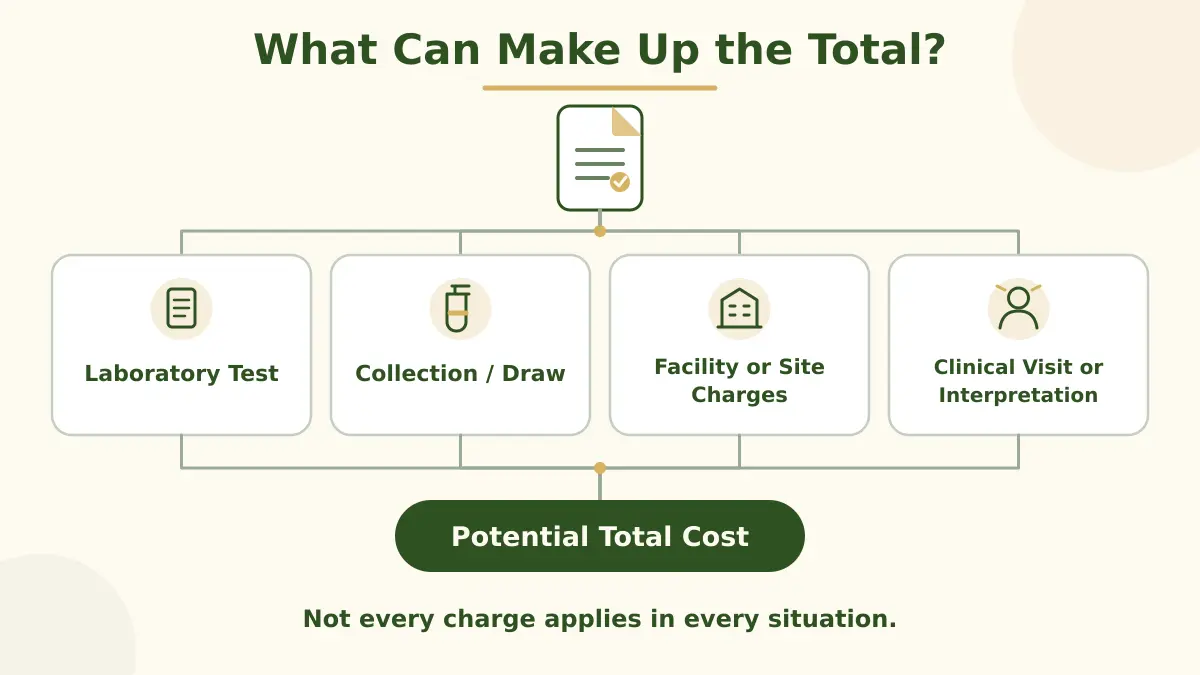
Several factors can contribute to differences in what patients ultimately pay for laboratory testing.
Where the blood is drawn
A draw at a hospital or hospital-affiliated clinic is priced differently from the same draw at a standalone patient service center. This is the single largest factor in most price differences.
Whether a facility fee applies
Hospital-affiliated care can involve facility or other site-related charges in addition to laboratory charges. Whether those fees apply and how much a patient owes depends on the facility, service, and insurance arrangement.
Who ordered it
Testing that begins with a separate clinical visit may involve the cost of that visit in addition to laboratory charges. The total therefore depends on both the laboratory price and any care required to order or interpret the test.
Geography
Regional variation is substantial. The same panel can differ meaningfully between a major metropolitan area and a rural one, in both directions depending on local competition.
When Insurance Costs More Than Paying Cash
This is the part that surprises people, and it is worth understanding before assuming coverage is the cheaper route.
Using insurance does not automatically mean a laboratory test will have the lowest immediate out-of-pocket price. If a covered service is subject to your deductible and you have not met it, you may be responsible for the plan's allowed amount. A separately available cash price may be higher or lower, depending on the laboratory, test, and insurance plan.
Cash-pay testing can involve another trade-off: amounts paid outside your insurance benefits generally do not contribute to your deductible. Before choosing between the two, compare the laboratory's cash price with the amount your plan says you would owe for the covered service.
Situation | Which route often costs less out of pocket |
Deductible already met | Insurance, since coinsurance applies to a negotiated rate |
High deductible, unlikely to be met | Cash pay is frequently lower, though the spend does not count toward the deductible |
Test not covered by the plan | Cash pay, since a non-covered test at a negotiated rate is the worst of both |
Preventive screening covered at 100 percent | Insurance, since the cost is zero to you |
If you plan to use insurance for laboratory testing, check your plan's ordering and coverage requirements before purchasing a test independently.
The Three Ways to Buy Lab Testing
Route | Potential cost components | Trade-off |
Physician visit plus hospital lab | Clinical visit + laboratory charges + any applicable facility or site-related charges | Full clinical context, results in your medical record |
Physician visit plus standalone lab | Clinical visit + laboratory charges | Clinical context with laboratory testing performed at a standalone location |
Direct-to-consumer platform | Published test price + any applicable ordering or collection fees | Clinical interpretation or follow-up may not be included |
Direct-to-consumer lab testing can provide another route to accessing laboratory services, with platforms typically publishing prices and arranging collection through participating locations.
What Cheap Lab Tests Can Cost You
Affordable lab tests and useful lab tests are not always the same purchase. The lowest sticker price is not always the lowest total cost, and this is where a cost article owes readers something more than a price list.
Interpretation is frequently not included. A panel that arrives as a PDF with several flagged values has produced data rather than an answer, and the follow-up appointment to interpret it is a cost the sticker did not show
Panel selection matters more than price per marker. A cheap panel containing markers unrelated to your question is not good value regardless of what it cost
Draw fees are sometimes separate. A published test price may not include the collection fee, so the cart total is the number that matters
Repeat testing costs again. A result that cannot be acted on often leads to a second, properly selected panel
Searching for cheap lab tests and searching for useful lab tests are different searches, and the answer is only occasionally the same.
How to Bring the Cost Down Without Losing the Value
For genuinely affordable blood work, ask whether the drawing site is hospital-affiliated before booking, since that single question often accounts for the largest part of the difference
Compare the bundled panel price against the sum of individual tests. Bundles frequently cost less per marker, though only if you need the markers included
Check whether the quoted price includes the draw fee
Ask whether interpretation is included and, if not, what it costs.
Use each laboratory's own cost estimator where available, since published ranges cannot account for your location
If you have insurance, check the negotiated rate against the cash price before assuming coverage is cheaper
How THRYVE Lab Costs and Membership Options Compare
THRYVE Wellness Medical uses diagnostic credits for eligible laboratory testing, with credits applied toward tests selected as part of the patient's care. Because individual test charges and membership benefits can change, current pricing should always be confirmed directly before purchasing.
Test | THRYVE Diagnostic Credits | Equivalent Cost |
Complete blood count (CBC) | 6 | $6 |
Lipid panel | 12 | $12 |
Thyroid stimulating hormone (TSH) | 15 | $15 |
Vitamin D, 25-hydroxy | 22 | $22 |
What About a THRYVE Membership?
For people who expect to need ongoing testing and follow-up rather than a single blood test, THRYVE also offers membership and one-time care options.
The current THRYVE Membership starts at $149, then $89 per month. It includes $100 in diagnostic credits per quarter toward 300+ advanced biomarkers, two 20-minute personalized telemedicine consultations, four 15-minute follow-up consultations per quarter, personalized health planning, and at-home blood draws by licensed phlebotomists.
For patients looking for a one-time option, THRYVE's Comprehensive Health Assessment is currently $399 and includes a 30-minute personalized telemedicine consultation, at-home mobile phlebotomy, $150 in diagnostic credits toward biomarker testing and advanced specialized testing, and a 15-minute follow-up consultation to review results and receive a personalized plan.
A standalone 20-minute telemedicine consultation is currently $69 and does not require membership.
The comparison is not strictly test price versus test price. THRYVE's membership and assessment options include services beyond laboratory testing, so the more useful comparison is the total cost and services included for the type of care a patient expects to use.
For the latest pricing, benefits, and available options, see THRYVE's membership options.
Frequently Asked Questions
How much does a blood test cost without insurance?
Common single tests generally run from around $15 to $85 in cash, with bundled wellness panels typically between $99 and $300. The range is wide because location, drawing site, and whether a facility fee applies affect the total more than the test itself does.
Why are lab test prices so different between providers?
Prices can differ because laboratories, collection sites, ordering arrangements, and insurance contracts vary. Hospital-affiliated care may also involve facility or site-related charges that do not apply in every setting.
Is it cheaper to pay cash than use insurance?
Sometimes. With a high deductible that has not been met, the negotiated rate paid in full can exceed a published cash price. The trade-off is that cash spending does not count toward the deductible, so the answer depends on your plan and how the year is likely to go.
Can you order your own lab tests?
Availability depends on the test and state law. Direct-to-consumer or direct-access testing is permitted in many situations, but state requirements can affect who may order a test and how it is provided. Check the platform's availability and requirements for your state before purchasing.
Are cheap lab tests reliable?
Price alone does not determine laboratory quality. In the United States, laboratories performing human diagnostic testing generally must meet applicable CLIA requirements. When comparing lower-cost options, check which laboratory performs the test, what the quoted price includes, and whether interpretation or follow-up is provided.
What is a facility fee?
A charge for using a hospital or hospital-affiliated building, applied on top of the test price and unrelated to the test performed. Asking whether a draw site is hospital-affiliated before booking is the single most useful cost question available.
Final Thoughts
Laboratory testing can carry out very different prices depending on where the test is ordered and collected, how it is billed, and which additional services or fees are involved.
That asks the most useful question less about finding the lowest advertised test price and more about understanding the total amount you may pay. Collection charges, applicable facility fees, ordering services, interpretation, and insurance cost-sharing can all affect that total.
Which asks the useful question not where to find the cheapest test, but what the total will be once the draw fee, any facility fee, and interpretation are included. That number is knowable in advance, and it is rarely the one advertised.
Compare THRYVE Testing and Membership Options
THRYVE Wellness Medical offers provider-guided lab testing with diagnostic credits and membership options for eligible patients in Texas, South Carolina, and North Carolina. Compare current membership benefits, testing credits, and included services before deciding which approach fits your needs.
Explore THRYVE Membership Options
This article is for general educational purposes. Pricing information is illustrative, changes frequently, and should be confirmed directly with any provider before purchase. It is not medical advice, and decisions about which tests are appropriate should be made with a qualified healthcare professional.