

THRYVE Team
Wellness Clinic
A vitamin D test measures 25-hydroxyvitamin D, but the USPSTF says evidence is insufficient to determine the benefits and harms of screening asymptomatic adults. Learn what the test measures, who may have a clinical reason for testing, and what results can and cannot tell you.
A vitamin D test measures 25-hydroxyvitamin D, the form used to assess vitamin D status. The US Preventive Services Task Force concluded that current evidence is insufficient to assess the balance of benefits and harms of screening for vitamin D deficiency in adults without symptoms. Testing is more informative when there is a specific clinical reason, such as symptoms, a condition affecting absorption, or another relevant clinical factor.
There is an important distinction between the availability of vitamin D testing and what preventive guidance says about screening asymptomatic adults.
That distinction is worth understanding before buying one, because it does not mean the test is useless. It means the value of testing depends partly on why it is being ordered and how the result will be interpreted.

What Does a Vitamin D Test Measure?
A vitamin D blood test measures 25-hydroxyvitamin D, often written as 25(OH)D. This is the form circulating in the blood and the one used to assess vitamin D status.
You may see it written several ways on an order or a report: vitamin D, 25-hydroxy; vit D blood test; vitd test; or simply vitamin D. These refer to the same measurement.
A different test measuring 1,25-dihydroxyvitamin D also exists. It is used in specific clinical situations rather than for assessing general vitamin D status, and it is not the test most people mean when they ask what blood test is for vitamin d.
What the Guidance Actually Says
This is the part most commercial pages leave out, and it changes how the rest of the article should be read.
The US Preventive Services Task Force concluded that current evidence is insufficient to assess the balance of benefits and harms of screening for vitamin D deficiency in asymptomatic adults. This is what the Task Force calls an I statement, meaning the evidence does not support a recommendation either for or against.
The Task Force also noted that no organization recommends population-based screening for vitamin D deficiency, and that the American Society for Clinical Pathology recommends against it.
Two details matter for what that means in practice.
The recommendation applies to community-dwelling, non-pregnant adults aged 18 or over who do not have signs or symptoms of deficiency, or conditions for which vitamin D treatment is recommended
It does not apply to people who are hospitalized, in institutional settings, or who have conditions that warrant testing
So this is not a statement that the test does not work. It means the USPSTF found insufficient evidence to determine the overall balance of benefits and harms of screening asymptomatic adults.
Why the Evidence Is Unsettled
It is worth knowing why, because the reason is more interesting than a simple lack of study.
The Task Force identified a foundational problem: vitamin D requirements can vary by individual, and there is no single 25(OH)D level that defines deficiency. The research questions it flagged as still open include whether total serum 25(OH)D is even the best measure of vitamin D status, and what cutoff should define deficiency.
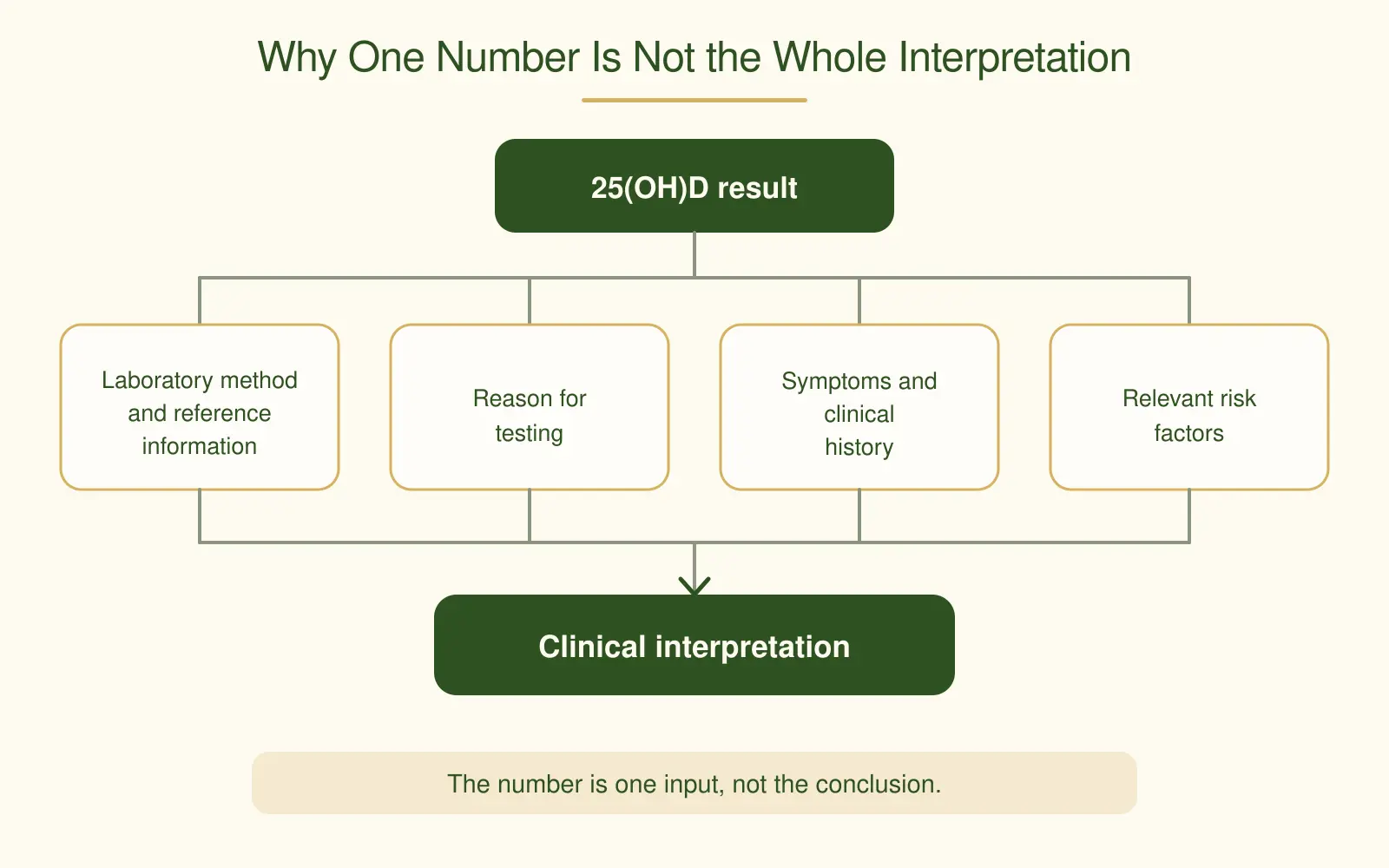
There is no single 25(OH)D cut point that defines deficiency for every individual, and test results can also vary by assay and laboratory method. That is one reason a laboratory value needs to be interpreted in context rather than treated as a universal cutoff.
When a Clinician May Consider Vitamin D Testing
A vitamin d deficiency test may be considered when there is a specific clinical reason to evaluate vitamin D status rather than simply as a general check.
Factors that can be associated with lower vitamin D levels, and that may make testing worth discussing with a clinician, include:
Limited sun exposure, including largely indoor lifestyles or covering clothing
Conditions affecting fat absorption, since vitamin D is fat-soluble
Previous bariatric surgery
Certain medications that affect vitamin D metabolism
Older age, and living in an institutional setting
Darker skin pigmentation, which reduces vitamin D synthesis from sunlight
Symptoms a clinician considers consistent with deficiency, assessed alongside everything else
This is not a self-assessment checklist. Matching an item on this list is a reason to raise the question with a clinician, not a conclusion that testing is needed or that a deficiency exists.
Do You Have to Fast for a Vitamin D Blood Test?
Do you have to fast for vitamin d blood test? Generally no. Follow the instructions supplied with your specific order, since a vitamin D test is frequently drawn alongside other tests that do require fasting.
That last point is the practical one. The fasting requirement usually comes from something else on the same order rather than from the vitamin D measurement itself. Our guide to fasting before a blood test covers what breaks a fast and what to do if you have already eaten.
At-Home Vitamin D Test Kits
An at home vitamin d test kit typically provides materials for collecting a sample that is then sent to a laboratory for analysis. Depending on the service, collection methods may differ.
Three things worth checking before buying one:
Which laboratory performs the analysis, and what quality or certification information the service provides
Whether interpretation is included, or whether you receive a number and nothing else
What you would do with the result, which is the question the guidance above makes relevant
That third point is especially important. A vitamin D test at home returns a laboratory value, but its usefulness still depends on the question being investigated and how the result is interpreted.
If you are comparing self-ordered options more broadly, our guide to direct-to-consumer lab testing explains what to check before purchasing laboratory testing yourself.

What a Result Does and Does Not Tell You
Because the threshold defining deficiency is not settled, a vitamin d lab test result is interpreted in context rather than read against a universal cutoff.
Results should be interpreted using the laboratory's reference information together with the testing method, clinical context and relevant professional guidance rather than by comparing a number with an isolated cutoff found online.
Do not begin, stop or substantially change vitamin D supplementation based only on a test result without discussing it with a qualified healthcare professional. Excessive vitamin D intake from supplements can cause toxicity, including abnormally high blood calcium levels.
What This Test Cannot Tell You
It does not diagnose a condition on its own. A value is interpreted alongside the clinical picture
It does not identify why a level is low. Different factors, including limited sun exposure, absorption problems and medication effects, may contribute to lower vitamin D levels
It does not indicate what supplementation, if any, is appropriate. That is a clinical decision
It does not measure the other nutrients people often assume are included. Vitamin D is a single measurement rather than a panel
Frequently Asked Questions
What blood test is for vitamin D?
The standard test measures 25-hydroxyvitamin D, written as 25(OH)D. It may appear on an order as vitamin D, 25-hydroxy, or simply as vitamin D. A separate test measuring 1,25-dihydroxyvitamin D exists but is used in specific clinical situations rather than for general status.
Should everyone get a vitamin D test?
The US Preventive Services Task Force concluded that evidence is insufficient to assess the balance of benefits and harms of screening asymptomatic adults, meaning it does not recommend either for or against. No organization recommends population-based screening. Testing may be considered when there is a specific clinical reason.
How do you check vitamin D levels?
How to check vitamin d levels: through a blood test measuring 25-hydroxyvitamin D. The sample can be a venous draw or, with some at-home kits, a finger-prick collection analyzed at a laboratory.
Do you have to fast for a vitamin D blood test?
Fasting is generally not required for the vitamin D measurement itself. However, it is often ordered alongside tests that do require fasting, so follow the instructions supplied with your specific order.
What does a low result mean?
It depends on context. There is no single 25(OH)D cut point defining deficiency for every individual, and results can vary by assay and laboratory method. A vitamin d testing result is interpreted alongside symptoms, risk factors, the testing method and the laboratory's reference information rather than against a fixed cutoff.
How much does a vitamin D test cost?
Vitamin d test cost varies by laboratory, location, collection method and insurance coverage. If you plan to use insurance, check your current benefits and any coverage requirements with your health plan and testing provider before testing.
Are at-home vitamin D test kits accurate?
At-home vitamin D tests generally involve collecting a sample that is analyzed by a laboratory. Reliability can depend on the collection method, sample handling, laboratory method and quality procedures. Before purchasing a vitamin d test kit, check who performs the analysis, how the sample is collected and whether clinical interpretation is available.
Is vitamin D the same as vitamin D3?
Vitamin D3, or cholecalciferol, is one form of vitamin D. The blood test measures 25-hydroxyvitamin D, which reflects vitamin D status regardless of which form it came from.
Final Thoughts
A vitamin D test measures 25-hydroxyvitamin D, the standard laboratory marker used to assess vitamin D status. For asymptomatic, community-dwelling, nonpregnant adults, the USPSTF concludes that current evidence is insufficient to determine the balance of benefits and harms of screening.
That is different from saying vitamin D testing has no clinical role. Testing may be considered in specific clinical circumstances, and the meaning of a result depends on why the test was ordered and how it is interpreted.
The useful question before testing is therefore not simply whether a vitamin D test is available, but what clinical question it is intended to answer.
Testing Chosen Around Your Question
THRYVE Wellness Medical offers at-home blood collection by licensed phlebotomists for eligible patients, with provider-guided care available through telehealth. Services are available to eligible patients in Texas, South Carolina, and North Carolina.
Medical Disclaimer: This article is for general educational purposes and is not a substitute for individualized medical advice, diagnosis, or treatment. It cannot interpret your results. Do not begin, stop or change any supplement based on a test result without a qualified healthcare professional involved.