

THRYVE Team
Wellness Clinic
Weight-loss plateaus are an expected feature of obesity treatment and do not necessarily mean treatment has stopped working. Learn why weight loss can stabilize with GLP-1 medications and why a plateau is a reason to discuss the treatment plan rather than change it independently.
Weight-loss plateaus are an expected feature of obesity interventions, including dietary restriction, GLP-1 receptor agonist treatment, and bariatric surgery. Reaching one does not by itself show that an intervention has stopped working. Reduced energy expenditure and increased appetite signals gradually narrow the energy gap that produced the loss, and a plateau is a reason to discuss the treatment plan with a prescriber rather than to change or stop treatment independently.
A semaglutide plateau tends to follow a familiar pattern: weight falls, the rate of loss slows, and eventually the scale may stabilize. Nothing about how the medication is being taken has necessarily changed, yet it is easy to reach the conclusion that it has stopped working.
The research says something different, and the difference matters for what happens next.

Plateaus Are Expected, Not Exceptional
This is the part most articles skip, and it reframes everything that follows.
Published modeling research on the physiology of the weight loss plateau describes plateaus as an expected feature of obesity interventions, with the paper opening on the observation that obesity interventions eventually result in a body weight plateau after which no further weight loss occurs. Dietary restriction, GLP-1 receptor agonist treatment and bariatric surgery are all described in those terms.
Intervention | When a plateau typically appears |
Calorie restriction | Commonly within 6 to 12 months |
GLP-1 receptor agonists | Often well after 12 months, with trial data showing weight loss slowing by around 60 to 72 weeks |
Bariatric surgery | A prolonged period of loss before plateauing |
Real-world data suggests plateaus can occur earlier than in trials. The point of the comparison is not the timing but the pattern: a plateau is not evidence that an intervention has failed. It can be what happens as an intervention works and the body reaches a new balance.
Searches for tirzepatide stopped working and GLP-1 not working anymore describe a real experience and a reasonable inference. The inference is the part that can be misleading.
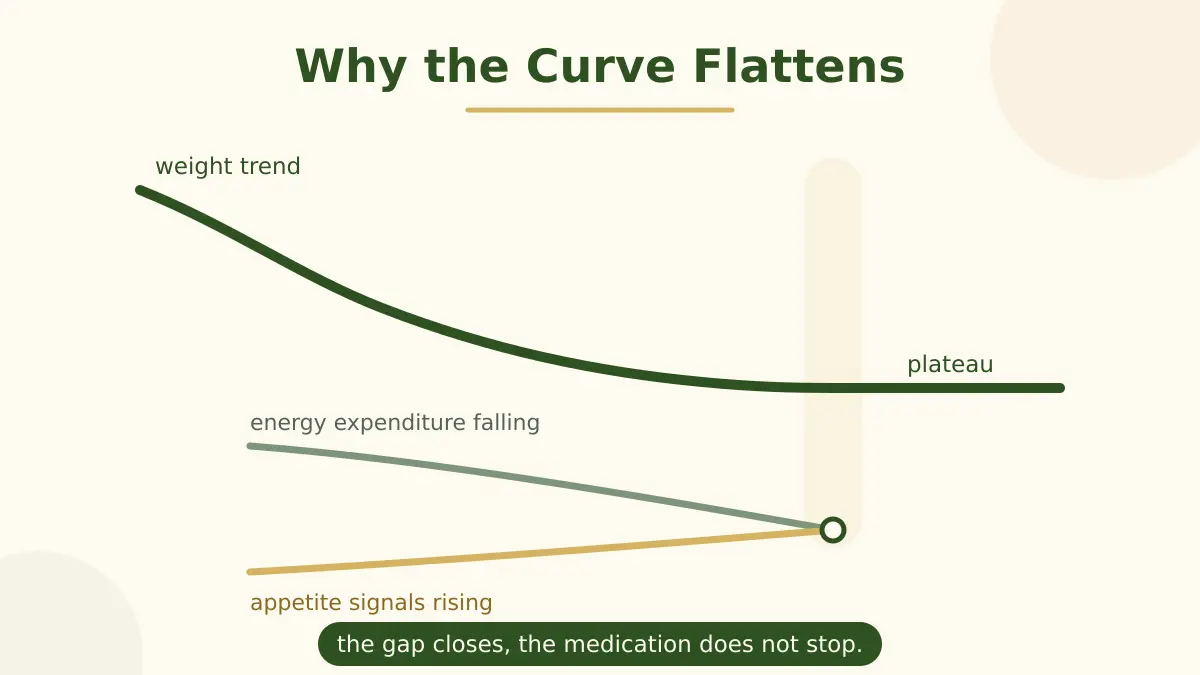
Research into weight-loss plateaus points toward changes in energy balance and physiological feedback rather than showing, from the plateau alone, that the medication has stopped exerting its effects. As weight decreases, the balance between energy intake and expenditure changes, and the gap that supported continued weight loss can narrow until weight stabilizes.
Two adaptations drive this, and they work together:
Energy expenditure falls. As weight decreases, the body requires less energy to maintain itself. Loss of lean mass alongside fat contributes to a decline in resting energy expenditure
Appetite signals rise. Weight loss triggers a feedback response that increases appetite, and that response grows stronger as more weight is lost
Together those narrow the energy gap that produced the weight loss. Eventually, the energy gap can narrow enough for weight to stabilize. A plateau therefore does not, by itself, establish that the medication has stopped exerting its pharmacologic effects.
Why GLP-1 Plateaus Arrive Later Than Diet Plateaus
If similar adaptations affect these interventions, why does dieting tend to plateau within months while medication can continue producing loss for a year or more?
The modeling research proposes that GLP-1 receptor agonism may weaken the appetite-feedback response that tends to oppose continued weight loss. This provides one possible explanation for why plateaus observed with GLP-1 treatment may occur later than those associated with dietary restriction alone.
A plateau still arrives on that account, because weakening a feedback response is not the same as removing it, and the decline in energy expenditure continues regardless.
One finding from that research is counterintuitive and worth stating: the modeling suggested the timing of a plateau is determined by the strength of the appetite feedback response rather than by the magnitude of the intervention once it reaches a steady level.
What a Plateau Is Not
Several conclusions people reach at this point are understandable and not supported.
Common conclusion | What the evidence indicates |
The medication stopped working | A plateau does not by itself establish that the medication has stopped exerting its pharmacologic effects |
My body built a tolerance | The research points toward adaptation in energy balance rather than a reduced response to the medication |
I did something wrong | Plateaus are described across the interventions studied, including surgical ones |
I need a higher dose | Dose may or may not be part of the discussion. It is a prescriber decision and not an inference to draw from a plateau |
This means treatment has failed | A plateau after substantial weight loss may represent a new maintained weight rather than evidence that treatment has failed |
The Bigger Risk Is Making the Next Decision Alone
A plateau can create a strong temptation to stop treatment or change a dose independently, particularly when stalled weight loss feels like evidence that treatment has failed. Neither conclusion should be drawn from the scale alone.
Stopping without discussion means the weight that has been lost is no longer supported by the mechanism that produced it. Self-adjusting a dose means changing a prescribed medication without the assessment that would normally accompany it.
Neither reaction is difficult to understand. Both can follow a situation that feels like treatment failure even though a plateau alone does not establish that treatment has failed.
What a plateau actually warrants is a conversation with the prescribing provider. That conversation may cover many things, and which ones apply depends entirely on the individual case.
What a Provider May Consider
This is not a list of things to request. It is a description of what the conversation can cover, so that arriving at it feels less like reporting a failure.
Where the plateau sits relative to expected trajectories and how long it has persisted
Whether the current dose and tirzepatide dose schedule are appropriate considerations for the individual treatment plan
Body composition rather than scale weight alone, since lean mass affects energy expenditure
Other medications or conditions that may be contributing
Nutrition and activity, including the role of resistance training and protein intake given the lean mass consideration. [CLINICIAN APPROVAL REQUIRED for this line. Do not add grams, targets, or exercise prescriptions]
Whether the current weight represents a reasonable place to maintain
That last point deserves more weight than it usually gets. A plateau reached after meaningful weight loss is not necessarily a problem to solve. It may be a result to maintain, and maintenance is a legitimate treatment goal rather than a consolation.

What to Bring to That Conversation
A plateau is easier to discuss with a few specifics, and none of them require any clinical knowledge.
Roughly when the rate of loss began to slow, and when it stopped
Weight measurements over the period, taken under similar conditions
Whether appetite has changed noticeably in recent weeks
Any changes to activity, sleep, stress, or other medications in the same period
Whether clothing fit has changed even where the scale has not, since body composition can shift without weight moving
That final point recurs across this topic. Scale weight is one measurement and it does not distinguish between fat and lean mass, which is why a plateau on the scale is not always a plateau in body composition.
Frequently Asked Questions
Is a semaglutide plateau normal?
A plateau on semaglutide is described in published research as the eventual outcome of every obesity intervention studied, including diet, medication, and surgery. Reaching one is expected rather than unusual.
Does a plateau mean the medication stopped working?
A plateau does not by itself establish that the medication has stopped exerting its pharmacologic effects. Reduced energy expenditure and increased appetite signals narrow the energy gap that produced the loss, which can be enough for weight to stabilize.
How long does a weight loss plateau on semaglutide last?
There is no established duration for a weight loss plateau semaglutide users experience. A plateau may represent a new stable weight rather than a temporary pause, and whether further loss is an appropriate goal is a clinical question rather than a timing one.
Should I increase my dose if weight loss has stalled?
Weight loss stalled on GLP-1 treatment is not on its own a reason to increase a dose. That is a prescriber decision and not a conclusion to draw from a plateau. Dose adjustment may or may not be appropriate depending on the individual case, current dose, tolerability, and other factors. Do not adjust a prescribed dose independently.
Why does weight loss slow down but not reverse?
Weight stabilizes when energy intake and expenditure reach a new balance. The medication continues to support that balance, which is different from the weight regain that can follow discontinuation.
Why do diet plateaus arrive sooner than medication plateaus?
Modeling research proposes that GLP-1 receptor agonism may weaken the appetite-feedback response that tends to oppose continued weight loss. That is one possible explanation for plateaus occurring later with these medications than with dietary restriction alone.
Final Thoughts
Weight-loss plateaus are an expected feature of obesity interventions and do not, by themselves, establish that treatment has stopped working. Research into plateau physiology points toward adaptations in energy expenditure and appetite feedback that can narrow the energy gap responsible for continued weight loss.
Knowing that changes what the moment means. It is not a verdict on the treatment or on the person, and it does not call for a decision made alone.
What it calls for is a conversation about what the current weight represents and whether the plan should change. Some plateaus are worth addressing and some are worth maintaining, and telling those apart is a clinical judgment rather than something to work out from a scale reading.
A Conversation Rather Than a Decision Alone
THRYVE Wellness Medical provides provider-led medical weight management by telehealth, with treatment decisions considered in the context of individual response, tolerability, and medical history. Available to eligible patients in Texas, South Carolina, and North Carolina.
Book a consultation with THRYVE
Medical Disclaimer: This article is for general educational purposes and is not a substitute for individualized medical advice, diagnosis, or treatment. Do not start, stop, adjust, or skip doses of any medication based on general information. If your weight loss has slowed, contact the provider managing your treatment.