

THRYVE Team
Wellness Clinic
Peptides and testosterone therapy get compared as though they are two routes to the same result. In most cases they are not. The peptides usually discussed under this heading act on a different hormonal system entirely, which changes what each one can reasonably be expected to do.
Testosterone replacement therapy supplies testosterone directly and reduces the body's own production while it is being taken. The peptides most often discussed alongside it, sermorelin and ipamorelin, are growth hormone secretagogues acting on a different hormonal system. Sermorelin and ipamorelin are not FDA-approved treatments for raising testosterone. These are not two versions of the same treatment, and comparing them requires knowing what each one acts on.
The comparison often starts from an assumption that both options do broadly the same thing by different means.
They generally do not serve the same therapeutic purpose, and the difference is worth understanding before either one is discussed with a provider.

The Assumption Worth Checking First
Searches for testosterone peptides, peptides for testosterone, peptides that increase testosterone, and what peptides increase testosterone carry substantial volume. The premise underneath them is that certain peptides raise testosterone the way TRT does, more gently or more naturally.
The compounds commonly discussed in this comparison, including sermorelin and ipamorelin, are growth hormone secretagogues rather than testosterone replacement therapies. Their primary pharmacologic targets are part of the growth hormone system: sermorelin acts as an analog of growth hormone-releasing hormone, while ipamorelin stimulates growth hormone release through the ghrelin receptor pathway.
That distinction matters. It does not mean these systems can never interact indirectly, but available evidence does not establish sermorelin or ipamorelin as equivalent substitutes for testosterone replacement in men with confirmed testosterone deficiency. Research into growth hormone secretagogues in this setting remains limited.
That does not mean these compounds have no potential clinical role. It means they are a different category of therapy addressing different physiological targets, and the comparison should begin there rather than treating them as interchangeable.
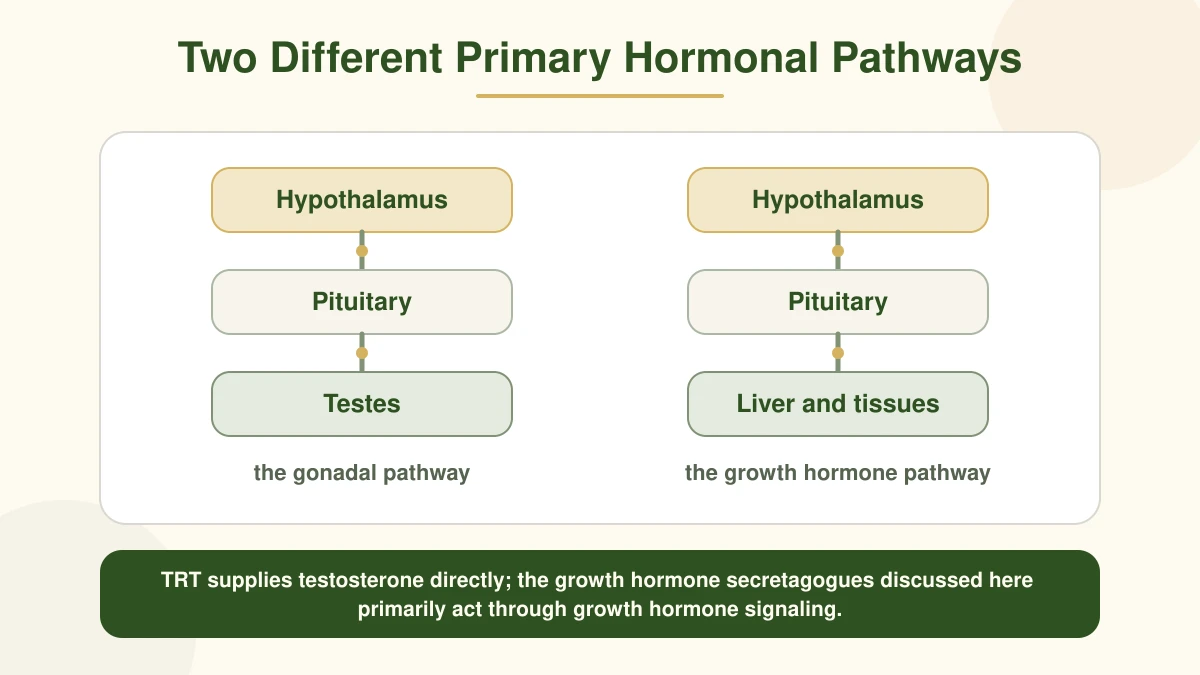
Two Different Primary Pathways
The body runs several hormone axes. The two relevant to this comparison are distinct, and each treatment acts primarily on one of them.
Comparison Point | Testosterone replacement | Growth hormone secretagogues discussed here |
Axis involved | Hypothalamic-pituitary-gonadal | Hypothalamic-pituitary-somatotropic |
What is administered | Testosterone | A growth hormone secretagogue |
Primary action | Supplies testosterone directly | Stimulates growth hormone signaling through compound-specific pathways |
Effect on natural production | Reduces it while treatment continues | Stimulates endogenous GH release rather than supplying testosterone directly |
Regulatory status | FDA-approved testosterone formulations exist | Not currently FDA-approved for treating testosterone deficiency; availability and compounding status require current verification |
One replaces, the other signals. That distinction runs through everything else, including monitoring, what happens when treatment stops, and what a prescriber is assessing before either is considered.
What Testosterone Replacement Therapy Involves
Testosterone replacement therapy has FDA-approved formulations and an established prescribing framework, so it is worth being clear about what treatment involves.
TRT supplies testosterone directly. FDA-approved formulations exist, the diagnostic pathway is established, and the evidence base spans decades. It is prescribed following confirmed low testosterone alongside symptoms, not on symptoms alone.
What it also involves:
Suppression of the body's own testosterone production while treatment continues
Implications for fertility, which is a significant consideration for some patients and a reason the conversation differs by life stage
Ongoing monitoring, since the prescribing information specifies laboratory values that require periodic review
A treatment that is generally continued rather than completed
None of that argues against it. It describes a treatment with FDA-approved formulations, established prescribing information, and defined monitoring considerations.
What Growth Hormone Secretagogues Involve
Sermorelin has a regulatory history that differs from many peptides marketed today. FDA-approved Geref products containing sermorelin were previously available for specific growth hormone-related uses, including treatment in selected pediatric patients, but those products are no longer commercially marketed. That historical approval should not be interpreted as current FDA approval of compounded sermorelin for testosterone deficiency, anti-aging, or general wellness use.
Mechanically, sermorelin is an analog of growth hormone releasing hormone. It prompts the pituitary to release growth hormone rather than supplying growth hormone directly, which means the body's own feedback regulation stays in the loop.
Ipamorelin acts through the ghrelin receptor pathway to stimulate growth hormone release. It is not an FDA-approved drug product, and FDA has raised safety concerns about the use of ipamorelin-related bulk substances in compounding, including limited safety information for proposed injectable routes. Its current regulatory and compounding status should therefore be verified at the time treatment is being considered.
Availability through compounding is not the same as FDA approval. Because regulatory and compounding policies can change, current availability should be confirmed with an appropriately licensed prescriber and pharmacy rather than inferred from an older article.
Where the Two Are Sometimes Discussed Together
Because their primary targets differ, they are not alternatives in the way the comparison implies. A published review of growth hormone secretagogues in hypogonadal males has explored these compounds as potential complementary or adjunctive therapies in men with hypogonadism or related body-composition concerns. However, the authors also emphasize that clinical evidence remains limited and that larger, longer-term studies are needed.
That should not be interpreted as evidence that these compounds can replace established evaluation or treatment for testosterone deficiency.
What an Evaluation Actually Considers
Regardless of which treatment brought someone to the evaluation, the assessment should begin with the underlying clinical question rather than a predetermined therapy.
Symptoms, how long they have been present, and how they have changed
Laboratory testing appropriate to the question, which for testosterone involves specific collection timing
Medical history, including conditions and medications that affect suitability
Fertility plans, which materially affect the testosterone conversation
What has been tried before and how it went
Whether the presenting concern is best addressed by either option, or by neither
That last point is not a formality. Several conditions can produce symptoms that overlap with those associated with low testosterone, including thyroid disorders, sleep problems, and depression. A thorough evaluation considers other plausible explanations rather than assuming testosterone is responsible for every symptom.

Access to Hormone Evaluation Across Texas
For eligible patients in Texas, hormone evaluation does not always require repeated trips to a traditional clinic. Depending on the service and clinical need, testing may be arranged with at-home blood collection, followed by provider review through telehealth.
That can be useful for patients across the Dallas-Fort Worth and Houston areas, including communities such as Plano, Frisco, Katy, and Sugar Land. The convenience changes where parts of the evaluation happen; it does not remove the clinical assessment itself.
Both involve prescription care and should be considered through an appropriate clinical evaluation rather than selected independently.
Frequently Asked Questions
Do peptides increase testosterone?
Sermorelin and ipamorelin are not FDA-approved treatments for raising testosterone. They are growth hormone secretagogues whose primary pharmacologic targets involve growth hormone signaling rather than testosterone replacement. Research has explored interactions between these hormonal systems, but that does not establish these compounds as substitutes for TRT.
Are peptides a natural alternative to TRT?
Growth hormone secretagogues stimulate endogenous growth hormone signaling rather than supplying testosterone directly. That mechanistic difference does not make them an established substitute for testosterone therapy, and a label such as natural does not by itself indicate that a treatment is safer or more effective.
Which is safer, peptides or TRT?
They carry different profiles rather than ranking against each other. TRT has FDA-approved formulations, an established evidence base, and defined monitoring requirements. The growth hormone secretagogues discussed here do not have current FDA approval for treating testosterone deficiency, and evidence for their use in this context is substantially more limited. Compounded products also do not undergo FDA premarket review for safety, effectiveness, and quality in the same way as FDA-approved drugs.
Can you take peptides and TRT together?
A published review has explored growth hormone secretagogues as potential adjunctive therapy in men receiving testosterone, but the evidence base remains limited. Whether any combination is appropriate is an individualized prescribing decision and should not be arranged independently.
Is sermorelin FDA-approved?
FDA-approved Geref products containing sermorelin existed historically for specific growth hormone-related uses, including treatment in selected pediatric patients, but those products are no longer commercially marketed. Historical approval does not mean compounded sermorelin is currently FDA-approved for testosterone deficiency, anti-aging, or general wellness use.
Do I need to visit a clinic in Dallas or Houston for this?
Not necessarily. For eligible THRYVE patients in supported service areas, parts of the hormone-evaluation process may include at-home blood collection and provider review through telehealth. The appropriate testing and treatment pathway still depends on an individual clinical assessment.
Final Thoughts
The comparison most people run assumes two routes to one destination. In practice, testosterone replacement acts on one hormonal axis and the peptides usually discussed alongside it act on another.
That distinction resolves much of the confusion. It explains why sermorelin and ipamorelin are not FDA-approved for raising testosterone, why the two are sometimes discussed as adjuncts rather than alternatives, and why labels such as natural are not enough to determine whether a treatment is appropriate.
What both have in common is that neither is appropriate to select for yourself. The useful step is an evaluation that establishes what is actually happening before either option enters the conversation.
Hormone Evaluation Across Texas, Without the Drive
THRYVE Wellness Medical provides provider-led hormone evaluation through telehealth, with at-home blood collection available to eligible patients in supported service areas. Services are available to eligible patients in Texas, South Carolina, and North Carolina.
Explore Hormone & Metabolic Health Care
Medical Disclaimer: This article is for general educational purposes and is not a substitute for individualized medical advice, diagnosis, or treatment. Both testosterone replacement therapy and the peptide therapies discussed here are prescription treatments requiring clinical evaluation. Do not start, stop, or change any treatment based on general information.