

THRYVE Team
Wellness Clinic
Compare tirzepatide vs. semaglutide, including how they work, what head-to-head trials found, key differences in weight outcomes and side effects, and why the better option depends on the individual.
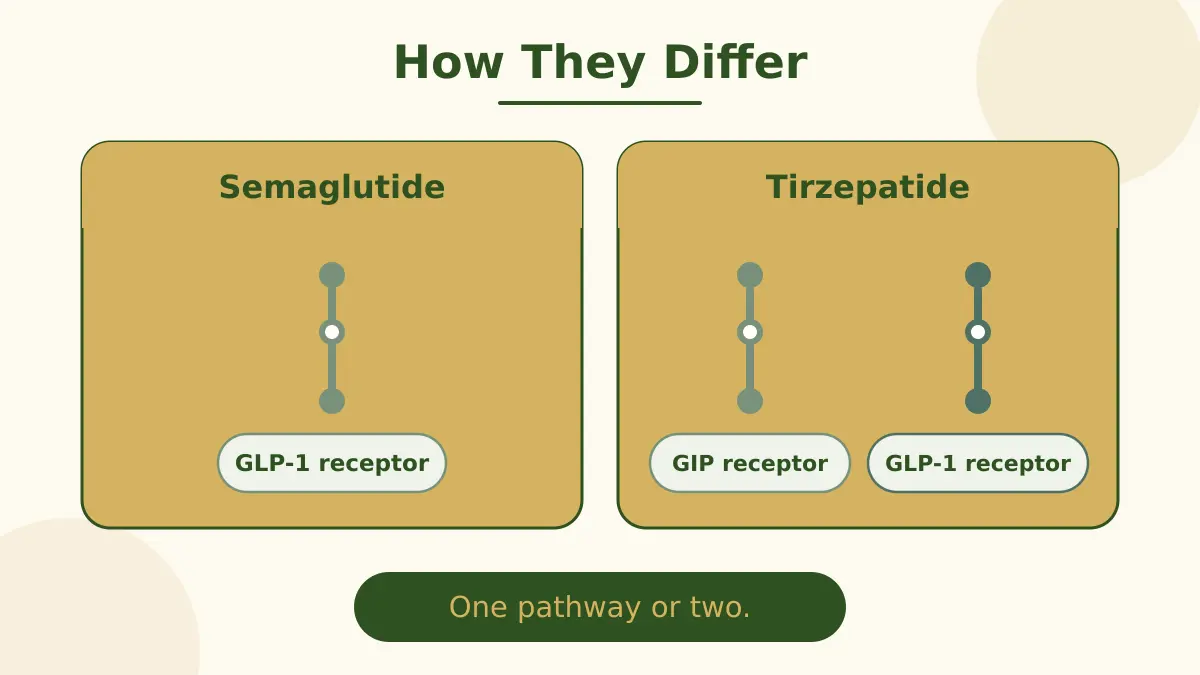
Semaglutide acts on one receptor pathway, GLP-1. Tirzepatide acts on two, GIP and GLP-1. In the SURMOUNT-5 head-to-head trial published in the New England Journal of Medicine, tirzepatide produced greater average weight reduction than semaglutide over 72 weeks in adults with obesity and without diabetes. Both are prescription medications, and which is appropriate for an individual depends on medical history, tolerability, other conditions, and access, not on trial averages alone.
Semaglutide vs tirzepatide is a comparison that gets discussed as though the two were versions of the same thing. They are not. The difference between semaglutide and tirzepatide begins with how they work, and understanding that pharmacologic distinction provides useful context for the comparison that follows.
For anyone weighing tirzepatide vs semaglutide for weight loss specifically, the head-to-head evidence now exists rather than having to be inferred from separate trials. This guide covers how each one works, what that comparison found, where the differences show up in practice, and why the question of which is better has more than one answer.

The Core Difference: One Pathway or Two
Both medications belong to a class called incretin therapies. Incretins are hormones the gut releases after eating, which signal to the body that food has arrived. Two of them matter here: GLP-1 and GIP.
Semaglutide is a GLP-1 receptor agonist. It mimics the action of GLP-1, which slows gastric emptying, affects appetite signaling, and stimulates insulin release in response to glucose.
Tirzepatide acts on both GIP and GLP-1 receptors. It was the first medication approved by the FDA to work on both pathways at once.
Tirzepatide's activity at both GIP and GLP-1 receptors is a key pharmacologic difference between the medications. How that difference contributes to clinical outcomes is more complex than receptor count alone.
Brand Names, and Why the Same Drug Has Two
A common source of confusion is that each medication is sold under different names depending on what it is approved to treat.
Medication | Brand Name | Approved For |
Semaglutide | Ozempic | Type 2 diabetes |
Semaglutide | Wegovy | Weight management |
Semaglutide | Rybelsus | Type 2 diabetes, taken orally |
Tirzepatide | Mounjaro | Type 2 diabetes |
Tirzepatide | Zepbound | Weight management |
Same active ingredient, different indication, different labeling, sometimes different dosing. Ozempic and Wegovy are both semaglutide. Mounjaro and Zepbound are both tirzepatide. So a search for mounjaro vs ozempic is asking the same underlying question as tirzepatide vs semaglutide, and a search for zepbound vs wegovy is that question in the weight management context specifically.
There is no FDA-approved oral or sublingual tirzepatide. Products marketed as compounded tirzepatide are not FDA-approved, and FDA restrictions on compounding these medications changed after the drug shortages were resolved. Patients considering a compounded product should discuss its regulatory status and appropriateness with a licensed clinician before purchase.
Two Head-to-Head Trials, Two Different Questions
Most comparisons of these medications draw on one trial. There are two, they studied different populations, and reading them together gives a more complete picture than either alone.
Trial Feature | SURPASS-2 | SURMOUNT-5 |
Population | 1,879 adults with type 2 diabetes | 751 adults with obesity, without diabetes |
Duration | 40 weeks | 72 weeks |
Design | Randomized, open-label, add-on to metformin | Randomized, open-label, active comparator |
Semaglutide dose | 1 mg | 1.7 or 2.4 mg |
Primary question | Change in HbA1c | Change in body weight |
Published | New England Journal of Medicine, 2021 | New England Journal of Medicine |
The dose column is the detail most comparisons omit, and it matters. SURPASS-2 compared tirzepatide against semaglutide 1 mg, which was the approved diabetes dose at the time. SURMOUNT-5 used 1.7 or 2.4 mg, the higher doses used in weight management. A comparison against a lower dose is not the same as a comparison against the maximum, and anyone reading SURPASS-2 as the definitive weight comparison is reading it beyond what it was designed to answer.
SURMOUNT-5: how it was designed
Phase 3b, randomized, open-label, active comparator
751 adults with obesity, or overweight with at least one related complication
Participants did not have type 2 diabetes
Mean age 45, conducted across 32 sites in the US and Puerto Rico
Maximum tolerated dose of tirzepatide or semaglutide, once weekly by injection, for 72 weeks
Published in the New England Journal of Medicine
SURMOUNT-5: what it showed
Outcome at 72 weeks | Tirzepatide | Semaglutide |
Mean change in body weight | -20.2% | -13.7% |
Average weight reduction | 22.8 kg | 15.0 kg |
Waist circumference reduction | 18.4 cm | 13.0 cm |
Tirzepatide also showed greater improvements than semaglutide across several cardiometabolic measures, including blood pressure, HbA1c, fasting insulin, triglycerides, and HDL cholesterol.
One finding worth noting for interpretation: weight reduction was approximately 6 percentage points lower in men than in women in both treatment groups. The trial included a higher proportion of men than most obesity trials, which the authors suggested may explain why overall reductions were somewhat lower than in earlier studies of either medication.
SURPASS-2: what it showed
In adults with type 2 diabetes on metformin, all three tirzepatide doses produced greater reductions in HbA1c and body weight than semaglutide 1 mg over 40 weeks. Tirzepatide was reported as both noninferior and superior on the primary endpoint of HbA1c change. At baseline, participants had a mean HbA1c of 8.28 percent, mean age 56.6, and mean weight 93.7 kg.
A post hoc analysis looked at something more clinically useful than any single measure: how many treatment targets participants reached at once. Using standard targets for HbA1c, blood pressure, LDL cholesterol, and weight, 34 percent of those on semaglutide met three or more, compared with 42, 53 and 57 percent on tirzepatide 5, 10 and 15 mg respectively.
That composite framing is worth more attention than it usually gets. Someone managing type 2 diabetes is rarely trying to move one number, and a medication that shifts several at once is answering the actual clinical question rather than a proxy for it.
What the trials do not establish
SURMOUNT-5 enrolled adults without type 2 diabetes and SURPASS-2 enrolled adults who had it. Neither describes the other population
Both were open-label, meaning participants and investigators knew which medication was being given
Both report group averages. Individual response varied considerably in every arm
Neither was designed to compare long-term cardiovascular events
Neither says anything about which medication a particular person should take
Why Better Depends on the Question
Asking why is tirzepatide better than semaglutide assumes weight reduction is the only axis of comparison. For a clinical decision it is one of several.
Consideration | What It Affects |
Tolerability | Gastrointestinal effects are common with both. Individual tolerability varies and is assessed clinically |
Other medical conditions | Some histories make one option more or less appropriate. This is a prescriber judgment |
Existing medications | Interactions and combined effects need review |
Insurance coverage | Coverage differs by plan, by brand, and by indication. This is frequently the deciding factor in practice |
Availability | Supply and formulary status vary and change |
Prior response | Someone who has already used one has information the trial cannot provide |
Dosing tolerance | Both are titrated upward. Not everyone reaches the maximum dose used in trials |
Asking is semaglutide or tirzepatide better therefore has two answers depending on what is being asked. The trial answers which produced more weight reduction on average in that population. It does not answer which is better for anyone in particular, and those are genuinely different questions.
Side Effects and Tolerability
Both medications share a broadly similar side effect profile, with gastrointestinal effects the most commonly reported. Nausea, vomiting, diarrhea, and constipation appear across the trial literature for both.
Two practical points that matter more than the lists:
Effects are often most noticeable during dose escalation and may lessen as the body adjusts, which is part of why both are titrated gradually rather than started at full dose
Individual tolerability varies, and how someone responds to one of these medications is a question to discuss with a prescriber rather than to predict from the other
Both carry labeled warnings and contraindications that a prescriber reviews against individual history. Those are not summarized here because they require individual assessment rather than a general list.

How a Prescriber Actually Chooses
Comparison articles stop at the trial data. In practice the decision runs through a sequence that trial percentages barely enter, and understanding that sequence explains why the choice often lands somewhere the research did not predict.
Indication comes first
Whether the goal is weight management, type 2 diabetes, or both determines which brand is being considered before any comparison happens. Zepbound and Wegovy are the weight management approvals; Mounjaro and Ozempic are the diabetes approvals. The treatment indication affects which FDA-approved product and coverage pathway may be relevant, and insurance coverage varies by plan, product, indication, and eligibility requirements.
History rules options in or out
Personal and family medical history, existing conditions, and current medications are reviewed against each medication's contraindications. This step removes options rather than ranking them, and for some people it removes both.
Coverage frequently decides it
This is the part patients are least prepared for and that comparison articles rarely mention. Formulary status, prior authorization requirements, and step therapy rules vary by plan and change during the year. It is common for the clinically preferred option and the covered option to differ.
Then the comparison matters
Only after those three filters does trial evidence enter, and by then the choice is often between one option and none rather than between two.
This ordering explains something that frustrates people: reading extensively about which medication performs better, then finding the decision made on grounds the articles never discussed.
Both are prescription medications. Neither is available without a prescriber assessment, and that assessment is where the comparison stops being general and starts being about a specific person.
Anyone researching these medications is also likely to encounter hormone therapy marketed for weight loss. That is a separate question with a different answer, which our article on hormone therapy and weight covers in full.

What Happens After Starting
Both medications are titrated, meaning treatment begins at a low dose and increases gradually. That process shapes the early experience more than the choice between the two.
Dose escalation is scheduled rather than immediate, and how quickly it proceeds depends on tolerability
Gastrointestinal effects are most commonly reported during escalation and may lessen at a stable dose
Not everyone reaches the maximum dose used in trials, which is one reason individual results differ from trial averages
Follow-up appointments assess response, tolerability, and whether to continue increasing
Trial results reflect participants who reached and maintained study doses over 40 or 72 weeks under supervision. That is a different situation from the first eight weeks of treatment, and expecting trial-level results early is a common source of discouragement.
If Coverage Is Denied
A denial is common and is not the end of the process. What follows depends on why it was denied.
Reason | What Usually Happens Next |
Prior authorization not submitted | The prescriber submits documentation supporting medical necessity |
Step therapy requirement | The plan requires trying a preferred alternative first. The prescriber may appeal or begin with the required option |
Indication not covered | Some plans cover the diabetes indication but exclude weight management. This is a plan design decision rather than a clinical one |
Documentation insufficient | Additional clinical information is supplied and the request resubmitted |
Depending on the reason for denial and the plan's rules, the prescriber may be able to submit additional documentation or pursue an appeal. Ask for the specific denial reason, because the available next steps depend on it.
If the First Option Does Not Work
Two situations come up, and they are handled differently.
Poor tolerability
Sometimes addressed by slowing the titration schedule rather than changing medication. Whether a switch is appropriate is a clinical judgment based on which effects are occurring and how severe they are.
Insufficient response
Assessed against how long treatment has continued, what dose has been reached, and whether the maximum tolerated dose has been given time. Changing course before that is established can mean abandoning something that had not yet been given a fair trial.
Neither situation is a reason to adjust or stop treatment independently. Both are reasons to bring it to the next appointment, or to request one sooner.
What Neither Comparison Answers
Two questions come up constantly alongside this comparison, and the honest answer to both is that the trial data does not address them.
How long does someone stay on either medication?
SURMOUNT-5 ran for 72 weeks. That tells you what happened over that period and nothing about what happens after it. Duration of treatment is a clinical decision made individually, and it is one of the more consequential conversations to have with a prescriber before starting rather than after.
What happens if treatment stops?
This is outside what the head-to-head trial examined. It is a reasonable question to raise during an initial consultation, and a prescriber can explain what the broader evidence indicates for the specific medication being considered.
Both questions matter more to most people than the difference between two percentages at 72 weeks. Neither is answered by a comparison article, including this one.
Frequently Asked Questions
What is the difference between semaglutide and tirzepatide?
Semaglutide acts on the GLP-1 receptor. Tirzepatide acts on both the GIP and GLP-1 receptors. Tirzepatide was the first medication approved by the FDA to work on both pathways at once.
Is semaglutide or tirzepatide better for weight loss?
In the SURMOUNT-5 head-to-head trial, tirzepatide produced greater average weight reduction over 72 weeks in adults with obesity and without diabetes. That is a group average in a specific population and does not determine which is appropriate for an individual.
Are Ozempic and Wegovy the same as Mounjaro and Zepbound?
No. Ozempic and Wegovy are both semaglutide, approved for type 2 diabetes and weight management respectively. Mounjaro and Zepbound are both tirzepatide, with the same split in indication.
Is there a tirzepatide pill or drops?
There is no FDA-approved oral or sublingual tirzepatide. Products marketed as drops are compounded and are not FDA-approved. An oral form of semaglutide is approved for type 2 diabetes under the brand name Rybelsus.
Why did my insurance cover one but not the other?
Formulary decisions are made by the plan rather than the prescriber, and they vary by plan and change during the year. Some plans cover the diabetes indication while excluding weight management, which is a plan design decision rather than a clinical one. Ask for the specific denial reason, because it helps determine what options may be available next, including whether additional documentation or an appeal is appropriate.
How long before either one works?
Both are titrated gradually, so the early weeks are spent reaching a therapeutic dose rather than at one. Trial results reflect participants who reached and maintained study doses over 40 or 72 weeks. Expecting trial-level results in the first two months is a common source of discouragement.
Can you switch between them?
Switching is a clinical decision involving dosing, titration, and individual history. It is not something to arrange independently. How someone responded to one medication is part of what a prescriber considers, and is a conversation to have rather than a prediction to make.
Final Thoughts
The pharmacologic difference is the useful thing to take away. Semaglutide acts primarily through the GLP-1 receptor, while tirzepatide acts through both GIP and GLP-1 receptors. That difference is important, but the difference in trial outcomes should not be attributed to receptor count alone.
On weight reduction specifically, the head-to-head evidence favors tirzepatide in the population studied. That is a real finding and worth knowing.
It is also not the same as knowing which medication suits a particular person. Tolerability, medical history, other medications, coverage, and prior response all bear on that, and none of them appear in a trial average. The comparison is a starting point for a conversation rather than a conclusion to act on.
A Decision That Depends on Your Situation
THRYVE Wellness Medical provides provider-led medical weight management, with treatment options assessed against your medical history, current medications, and individual circumstances. Available to patients in Texas, South Carolina, and North Carolina.
Book a consultation with THRYVE
Medical Disclaimer: This article is for general educational purposes and is not a substitute for individualized medical advice, diagnosis, or treatment. Both medications discussed are available by prescription only. Do not start, stop, or change any medication based on general information. Speak with a qualified healthcare professional about your own circumstances.